
“Life goes on” and “time doesn’t stop for anyone”; there is a poignancy to these phrases that we ignore. Oftentimes, these lines are uttered as condolences to ease the pain of grief or loss. But, I wonder if it truly is a thing of comfort—at a cursory glance perhaps yes—the idea that life finds a way to continue no matter the loss can be liberating. However, if we pause and wonder, these phrases speak of the apathy of life and time towards individuals. Life is uncaring and indifferent to our tragedies, and time propels change — and then one day we get too old to keep up with both — time and change.
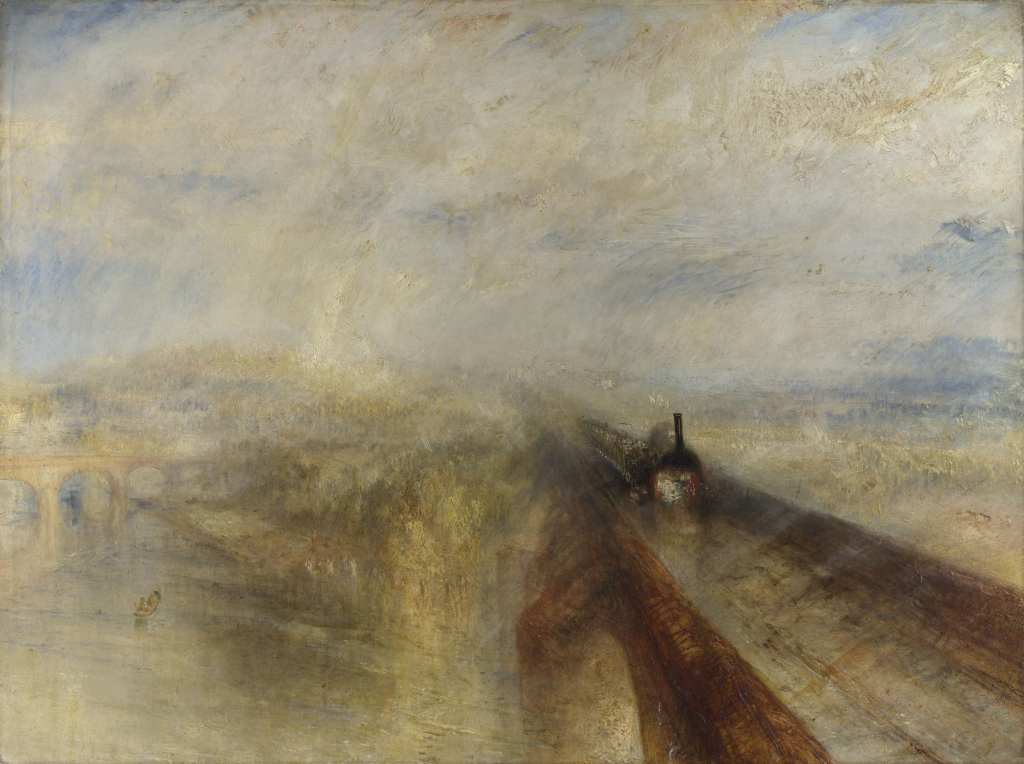
William Turner’s painting “Rain, Steam and Speed – The Great Western Railway” (1844) portrays a train rushing towards the viewer through a blur of steam and mist along a dark bridge, threatening to come hurtling out of the canvas. It was the 19th century, a time when human innovation shaped the face of the modern world. No time in the history of mankind till then had seen progress at such speed. Turner was a master of movement in painting, and this painting carries the rush of speed, a speed representative of that era. A speed that will make the familiar old, rapidly.
With the advent of trains, it was for the first time that humankind experienced a kind of speed that was incomparable to one achieved through earlier modes of transport. Turner in painting the steam engine, painted the story that turned a leaf in the human epoch, and he placed the viewer at the cusp of a past era witnessing the train’s emergence, rendering that past obsolete.
The train and the bridge in the painting are painted in darker hues, of blacks and browns, which extract them against the rest of the canvas that is flushed in light. The train itself embodies movement; it comes from a blur of nothingness, and the effect of the foreshortening adds to the sheer speed of the locomotive — the speed of the modern world. If you look closely, the train is an un-roofed one, and traveling in that train at the speeds of 33mph to 60mph — the speed range of the Great Western Railway engine — would have accorded passengers a new way of seeing the world. The rush of the wind on the face, the landscape speeding by, the puffs of steam mixed with the rain and clouds — Turner masterfully painted that experience. The viewer watches the train coming at them, while also experiencing the sheer speed as the passengers on that train would have.
The train has a seemingly Gothic look to it. This, along with the rain is perhaps a nod to the Romantics. There is an element of the sublime in it. The use of bold red on the front of the engine, set against the mildly washed landscape, vividly portrays the engine’s heat. The landscape washed with light on either side of the bridge is receding backward. There is another bridge we see in the painting; it’s a footbridge and it looks desolate, still, and forgotten. One can even say it appears redundant.
Even with bridges, it is the ones that can carry the weight of the trains that are the connectors of the future; the ones that can’t, age against the indifference of the changing times.
Turner greets the old times by featuring various other means of transport. On the right side of the painting, we can see a man who seems to be driving a horse-drawn plow, which faces backward while the train rushes on forward. The horses, a swift mode of transportation at that time, appear incredibly still (like cave paintings) compared to the locomotive, while the train rushes forward animatedly. The cattle and the farmer under a haze of light are already turning into still images of a time gone by. Not only can it not keep up with the raging train, but it is also like the horse-drawn carriage is moving towards the back of the painting.
We see a similar story being etched on the left side of the bridge: two people are rowing the boat in the opposite direction(away from the viewer). The boat is yet another old means of transport that doesn’t, relatively, convey a sense of movement.
What Turner paints is the progress of human movement—the footbridge, horse-drawn carriage, the boat, are clearing the way for the steam engine.
The boat is headed towards the shore, where we see figures of women. They carry a familiarity with Lorrain’s work who painted mythological figures in his landscapes. It seems yet again, that Turner is paying respect to a time and tradition gone by. The figures of women on the shore are from a different time. They look like a painting of Claude Lorrain, a painting that preserves the past in its still image and mythical quality.
Earlier prints of the painting show a hare running in front of the train. The hare is the only other thing, besides the train that shows movement, and is headed in the same direction as the train. However, the painting carries the dreadful foreknowledge that the steaming hot engine of the train will catch up with the hare and crush it to its death. With time the colors have faded and so has the hare; a very faint impression of it remains. Is it not interesting? The hare did not keep up with the time it was running against. Time did catch up with it to erase it, while the train remains in motion rushing towards the viewer.
The halo-like light imparts a memory-like quality to the rest of the canvas
Go against the grain of time and you turn into a memory, like the people in the boat and the farmer with the horses. . Try to race with it without adopting the ways of the time, you will be crushed. Movement and time are irrevocably bound in this painting. Movement, at the turn of the century in 1896, will be the legacy of films, and yet again it will be a train coming into the station shot by the Lumière Brothers that will threaten the audience so that they scream and run to the back of the theater.
The center of the painting is just clouds and rain, the viewer is standing somewhere between the bridge with the train and the landscape on its left side. The viewer then is not on solid ground; the precarious position of changing times, watching a speeding future against the stillness of the past. “Life goes on”, and it moves at a new speed in spite of us.
If you love rains as much as I do, I think you will enjoy this little piece on Rains
Bibliography
1. Rain, Steam, and Speed – The Great Western Railway, William Turner, pxfuel.com.
2. Brunel, Isambard Kingdom, et al. “Joseph Mallord William Turner | Rain, Steam, and Speed – The Great Western Railway | NG538.” National Gallery, https://www.nationalgallery.org.uk/paintings/joseph-mallord-william-turner-rain-steam-and-speed-the-great-western-railway. Accessed 3 December 2023.
3. Carter, Ian. “Rain, Steam and What?” Oxford Art Journal, vol. 20, no. 2, 1997, pp. 3–12. JSTOR, http://www.jstor.org/stable/1360665. Accessed 3 Dec. 2023.
 BooksArtAndMusings