
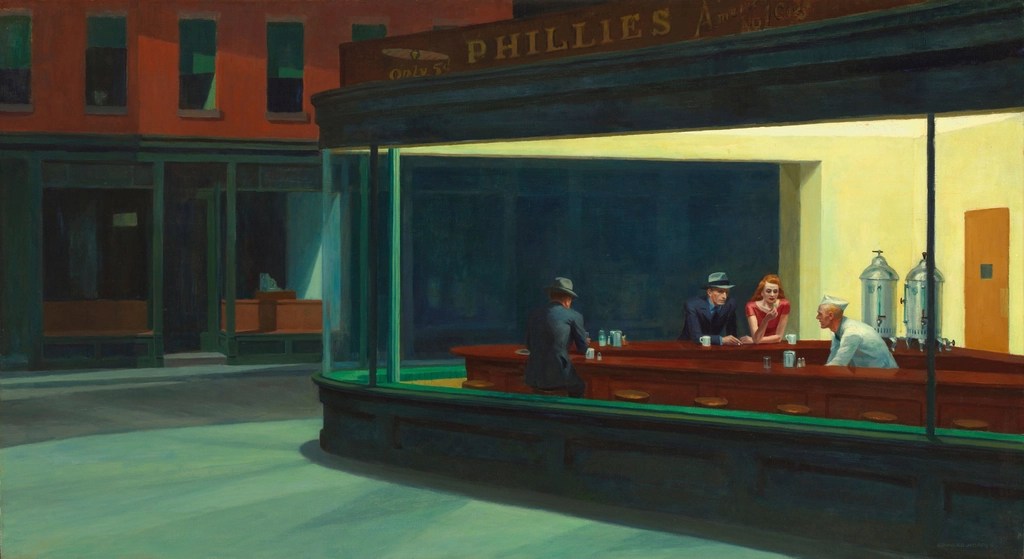
I was traveling by train recently, and while the passengers boarded, I happened to look at the small makeshift establishments that had sprouted near the tracks. In those tiny houses with fluorescent lights, the entire family was up for display. I watched them, curious, imagining the life they lead. A bright blue tarp (that served as a partition of the room) flapped in the crusty winter winds; inside the train, I couldn’t hear it. A little girl stepped up to adjust it to the side and then looked in my direction with the same curiosity in her eyes. For a moment, I had forgotten that with the train lighted up, I too was on display. I froze, and she kept looking, holding me hostage with her eyes. Nighthawks by Edward Hopper reminded me of the same eerie feeling, the same still sadness.
Edward Hopper’s Nighthawks: A Masterpiece of Isolation
Nighthawks is one of Hopper’s most famous paintings. It features a solitary diner illuminated by stark, artificial light against a darkened city. The contrast is jarring—the diner’s harsh glow disturbs the quiet, resting space around it. The light is bold yet lifeless, sharp yet detached.
Inside the diner, four subjects sit in silence, lost in their own worlds. Their faces are devoid of expression, their postures tired and defeated. None interacts with the others. A man and a woman sit close, their hands near enough to touch, yet they miss each other completely. The scene evokes a modern sense of disconnection. If we were to place smartphones in their hands, the painting would become a 21st-century Hopper—a portrait of distracted loneliness, now more insidious than ever.
The Sound of Silence: A City’s Shared Loneliness
Few paintings seem to carry a sound of their own. Nighthawks is hauntingly silent. It captures the peculiar silence of a city—a silence that places people in close proximity only to keep them estranged. This silence is not the absence of sound but rather the absence of conversation. Over time, this silence has settled, hardened, and matured to be seen rather than heard. It’s the silence of a language that has shrunk into overused templates, blending into repetitive, unimaginative white noise. And yet, it’s a shared silence—the silence of a shared loneliness.
Voyeurism and the Power of Windows in Hopper’s Work
The scene in Nighthawks is staged like a theater set, artificially lit with harsh lights against a dark background, inviting a voyeuristic gaze. Even the diner’s windows are in collusion with this intent. Hopper paints them unusually clear. The glass is not painted in a realist manner—it’s not fogged up, or reflecting light, or streaked with dirt. Hopper’s windows serve no purpose other than to trap the subjects inside, making them vulnerable to the viewer’s gaze.
These clear, almost absent windows are a recurring motif in Hopper’s work. His windows do not shield his subjects; they expose them. The placement of the viewer is also significant. We, as viewers, are positioned on the other side of the street, looking in at an angle. If the perspective were from the front, the subjects in the diner would be conscious performers in a public space. But from this angle, we are eavesdropping, catching them in a vulnerable moment—revealing, not performing.
Stillness vs. Motion: A Contrast to Turner’s Rain, Steam, and Speed
Movement makes sound; stillness is silent. There is a stillness to Nighthawks. Compare it to J.M.W. Turner’s Rain, Steam, and Speed – The Great Western Railway, where hazy lines convey sheer velocity. In contrast, Hopper’s lines are bold and containing; they do not bleed into each other but instead block and bind the scene. The composition confines four people in a restaurant with no visible doors and clear windows. The only way to access this diner is through sight.
Looking and being looked at are central to Hopper’s work—and to paintings in general. Paintings are meant to be pondered over; you cannot simply scroll past them. They invite stillness. While a Turner makes you see movement, a Hopper forces you to confront stillness.
A Sailor Adrift on A Dark Sea
The only figure in motion is the server, dressed almost like a sailor. Yet, his movement feels mechanical, blending seamlessly into the diner’s overall stillness. The sharp angles of the diner and its glowing light make it resemble a ship—a lone vessel adrift in an ocean of urban darkness.
Hopper often incorporated nautical references into his work, and here, the server appears as a sailor navigating the still waters of the night on a lone lighted ship, waiting for a tide that may never come. There are moments in life when we act and moments when we simply wait. Perhaps this is a painting about waiting—about the great waiting of uncertain times. Or the waiting of modern life, the dread and loneliness of a disconnected existence numbed by the plodding of routine
Historical Context: A Beacon in the Darkness of War
Nighthawks was painted just weeks after the bombing of Pearl Harbor. Blackouts were frequent in the city that lived under the constant anxiety of another attack. In all this Hopper, would keep the lights of his studio on, painting through the night. You can call it bravery, rebellion, or just irreverence to war. It’s the same irrelevance that the lighted-up diner displays against its surroundings, or the irrelevance that life shows against great peril. Not in the triumphant way, with pomp and show, but by snuggling up in a single lighted-up space and continuing. Sometimes, that is all one can do.
A Study in Perseverance and Isolation
Four people sit inside the diner, each lost in their own world. How big and complicated those worlds must be. Nighthawks is not just a painting of loneliness—it is also a painting of perseverance. Each figure, despite their vacant expressions, continues onward, caught in their personal struggles and their unspoken need for connection.
As we gaze into the diner, its light spills out, illuminating us as well. And suddenly, the roles reverse. Hopper’s painting reminds us that we, too, are on display—watched by others as we watch them. The little girl on the side of the train tracks comes to mind, staring at me as if asking how it feels to be behind that clear glass window.
Bibliography
Stanton, Joseph. “ON EDGE: Edward Hopper’s Narrative Stillness.” Soundings: An Interdisciplinary Journal, vol. 77, no. 1/2, 1994, pp. 21–40. JSTOR, http://www.jstor.org/stable/41178875. Accessed 2 Feb. 2025.
Nerdwriter, Hopper’s Nighthawks: Look Through The Window, YouTube, Sep 30, 2015, https://www.youtube.com/watch?v=7j5pUtRcNX4&t=338s&ab_channel=Nerdwriter1
Doss, Erika. “Hopper’s Cool: Modernism and Emotional Restraint.” American Art, vol. 29, no. 3, 2015, pp. 2–27. JSTOR, https://doi.org/10.1086/684918. Accessed 2 Feb. 2025.

