Two roads diverged in a wood, and I—
I took the one less traveled by,
And that has made all the difference.
—Robert Frost
It was the fifth standard, and all the students in the class were trying to adapt to a change; for the first time, we were writing with pens instead of pencils. On a neat new notebook, as our teacher dictated a few lines for us to write down, I made a spelling mistake. Instinctively, I reached for the eraser kept to my side and then caught myself. There were no clean re-dos anymore. It hurt to strike through the words on the crisp new paper of my fresh notebook to make the correction.
In hindsight, I think that was the first of the many moments where I was expected to grow up. Writing with a pen made me more careful. There were consequences to my choices, and the white fluid wasn’t fooling anyone.
Adult mistakes have visible consequences, and so do adult choices. Since that time, I have made many of those choices, which have rendered my life as it is today. Throughout my life, I have carried the anxiety of choices and then carried the rather redundant anxiety of whether I made the right one.
I suppose you can guess; I am the kind of person who dwells on what-ifs. Do not confuse this with simple regrets—of which I have a few. It is curiosity. What if I had taken that other road? What person would I have been today? Would I have liked her better? That other road is the story that I didn’t get to live. Is it not natural to think that that story was the better one? —for me.
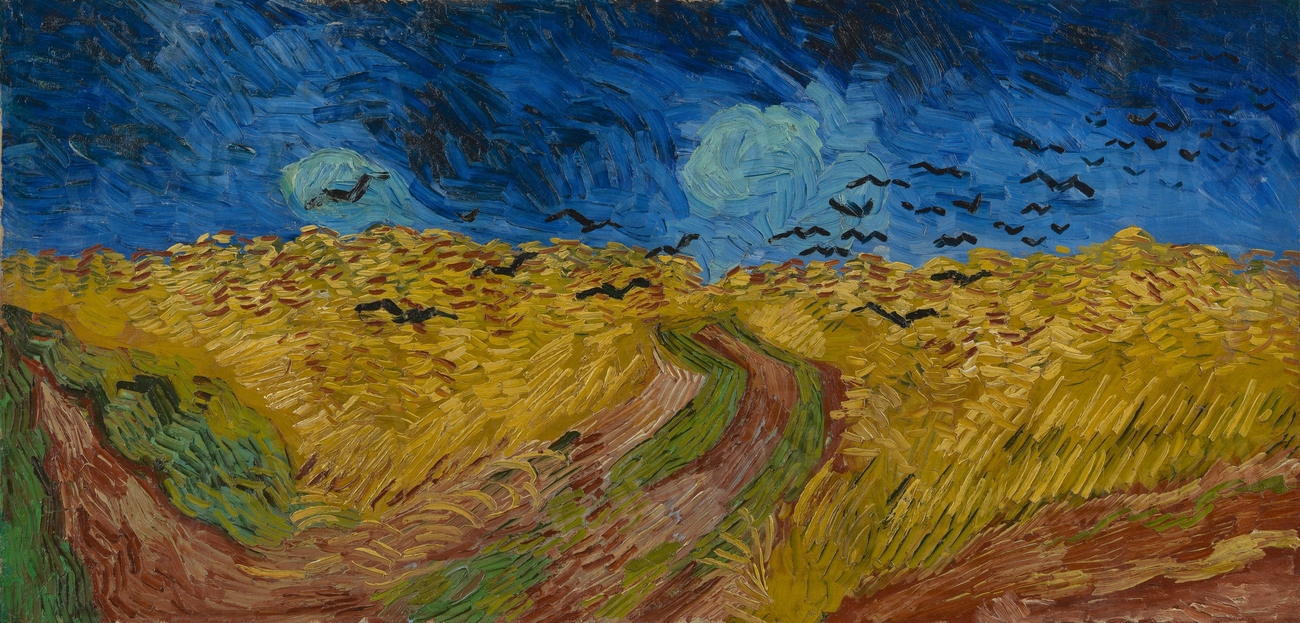
When I first saw the painting Wheatfield Crows, it reminded me of Frost’s poem “The Road Not Taken”— which in turn reminded me of the first time I used a pen on paper. Both these pieces of art represented to me the essence of adulthood: choices and time. Let me elaborate
In the painting, we see three roads along the wheat field, under what looks like a stormy blue sky. Three roads; In stories and fairy tales, three is a recurring number. You get three wishes from a genie, the third bed is the most comfortable, and the third time is the charm. Twice is a coincidence, and thrice is a pattern.
In fairy tales, perhaps you can make all three choices and learn from experience which is the right one. In life, that is usually not possible. At some point in our lives, we realize what we have known all along: life is finite. We become conscious of time. Around the same time, a year, which lasted for ages in childhood, begins to shrink. Then one birthday, you find yourself crying because you’re growing old and your twenty-eight doesn’t look remotely as stable as the twenty-eight of your parents or your peers.
Ten years from now as you are approaching your 40s, you’d think, why did I ever think I was old at twenty-eight? I could have done so much. But at twenty-eight, I was thinking of being eighteen and wondering about the road not taken. Hoping that a genie would give me a decade of my life back, because this time I’d live it better, or I’d live more. At eighteen, the ink on the paper hadn’t dried yet. At eighteen, the story of my life was still written in pencil.
I only wish to write with a pencil again, because I am not too sure about life—not yet. Till the time I was still writing with pencils and the years of my childhood felt like forever, I could take all three roads. Time was generous, and life was forgiving.
Troubled with impostor syndrome, I would hardly admit to having any credible talent. But I must say I am distinctly gifted in the art of pessimism and courting sadness. When I first looked at this, it made me sad; I felt an emptiness accompanied by a feeling of loss. They are different; feeling empty and feeling a loss. Empty demands to be filled with something; it is a form of incompleteness. Loss is knowing the contours of emptiness. Loss is knowing what is missing. It’s unique, and you can’t fill it up with other things; they never quite fit there. Nothing causes more regret than knowing you’ve led an empty life. In my experience, loss in the form of grief can last a lifetime; emptiness doesn’t have to.
I had lost time, so much time to troubles and troublesome people. I lost a childhood. And I felt empty, for I couldn’t be all I wanted to be, and I thought I could only be that if I began at eighteen again. Told you I have a talent for sadness. Now I know I don’t have all the time in the world, and I am only growing older.
In the twenty-eighth year of my life, I looked at the painting again and felt the familiar loss and emptiness again. Then, something changed; for the first time, I figured that the deep sadness inside me was a sadness for life, a want for life. I only wanted to live, and I regret that I didn’t. Seems simple, doesn’t it? How could I not see it before? And yet, I didn’t; that is how blind one can be to the obvious hope when one is lost.
Hope, however, is terrifying; it requires work. Hope lets you see something better, and once you see it, the dark place that you had made your home gets darker. Sadness after a prolonged period can lull you into a passive stupor, and you stop struggling. Hope makes you uncomfortable again; you wake up flailing and panicking to the realization that so much of life is lost.
I have to make my peace with my loss; I have to start filling up the empty. But mostly, I have to learn to live again. This last one is the hardest when it’s not instinctual.
From here on, the road I took diverges again, and I will choose again. I will always have the choice. As I cross over my mistakes, maybe it is good to look back and see the journey etched in ink. At some point in my life, I lost the eraser under the bed and never found it. It sits there with the dirt and the webs and the dust of forgotten things. No more clean starts for me. Even when life forces me to begin at the beginning, my beginnings come with the clutter and markings of time. Then again, all that clutter is life too. So, if I have to begin again, I begin with more life than I started with. There is something reassuring about that.
In the painting, we also see crows flying over the roads. Crows in many cultures are seen as omens of death or symbols of change. Considering death is a form of change—the ultimate one—the symbolism is consistent. The viewer in the painting is placed at the point of decision, at the point of choice. And crows fly over the wheat field, reminding us not only that our time is limited but also that choices lead to change. It took me years to see the painting in that light, to see that life, even at twenty-eight, offers us change.
I’m sure the painting will take on new meanings as I grow up. I wonder how it would have changed for me.
I can’t remember where I heard it, but someone tried to explain once how big the universe is in a unique way. They said that the universe is so big that everything that can happen will happen, however unlikely it is. In the universe, all the ways in the wheat field will exist, and all versions of the stories will happen in boundless timelessness. You and I get this one brief life, one version, one way in the wheat field at a moment; the only thing we owe to our unique life is to live it well.
Looking at things like this reminds me of another Robert Frost poem
The woods are lovely, dark and deep,
But I have promises to keep,
And miles to go before I sleep,
And miles to go before I sleep.
—Robert Frost
Interested in art?, check out my thoughts on Nighthawks by Edward Hopper

